
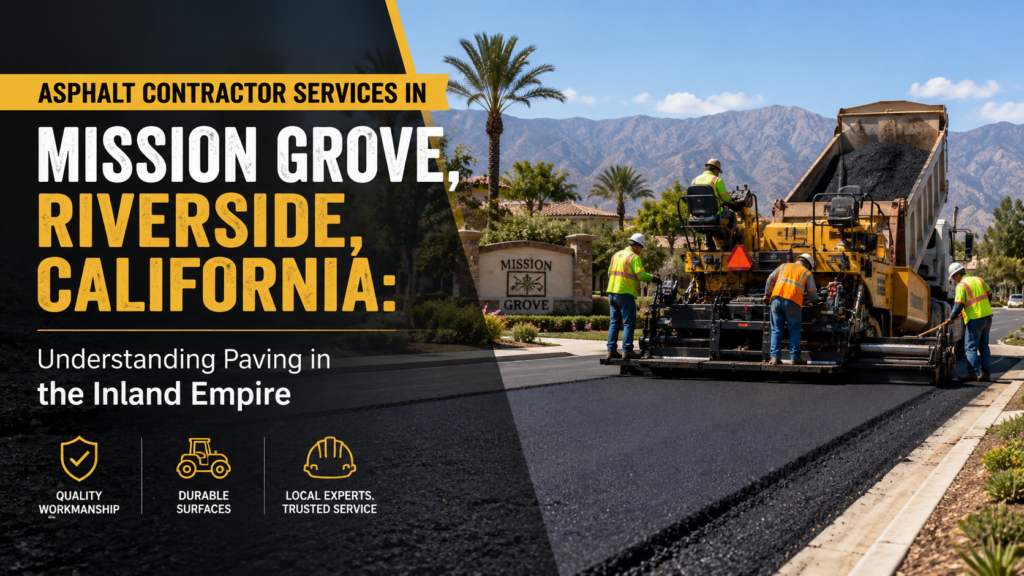
Mission Grove is a neighborhood in southeastern Riverside, California, situated adjacent to Orangecrest and sharing much of that community’s master-planned character. Named in part for the Mission Inn the historic landmark that anchors Riverside’s identity Mission Grove represents the newer residential development that expanded the city’s southeastern edge during the late twentieth century. With its planned street network, predominantly owner-occupied homes, proximity to schools and commercial centers, and the warm, sun-drenched climate of the Inland Empire, Mission Grove creates a consistent context for Asphalt Contractor Mission Grove paving services. Property owners here face the same Southern California paving realities as their neighbors in Orangecrest and Canyon Crest UV oxidation, thermal cycling, and the steady aging of surfaces installed during the neighborhood’s development period but in a community character that values well-maintained properties.
The Asphalt Paving Lifecycle in Mission Grove’s Climate
Understanding the lifecycle of asphalt in Mission Grove’s climate is the starting point for managing paving assets effectively. In Riverside’s Inland Empire climate, a well-installed asphalt surface progresses through predictable stages:
- New asphalt (0-3 years): Fresh asphalt is flexible, dense, and dark black. The surface is at its best performance level. This is the time for initial sealcoating typically applied 6 to 12 months after installation to protect the binder from UV oxidation before the first cracks develop.
- Good condition (3-8 years with maintenance): With regular sealcoating every 2 to 3 years and prompt crack filling as minor cracks appear, asphalt maintains good functional condition during this period. Surfaces in this stage benefit from continued sealcoating and crack maintenance.
- Fair condition (8-15 years): UV oxidation has caused the surface to gray and develop surface cracking. More extensive crack filling is needed. Depending on the extent of deterioration and base condition, resurfacing may be appropriate during this period to prevent deterioration from reaching the base.
- Poor condition (15+ years without maintenance): Extensive cracking, raveling, and potential base damage. Depending on base condition, either resurfacing or full replacement may be required. This stage is avoidable with consistent maintenance during the earlier phases.
Driveway Paving for Mission Grove Homeowners
Residential driveway paving is the most common asphalt service in Mission Grove. The neighborhood’s homes predominantly single-family residences built in the 1980s and 1990s are reaching the age range where original driveways installed during construction are approaching or past their optimal maintenance window. Mission Grove homeowners in this situation face a straightforward decision: determine whether the existing driveway’s base is sound enough for resurfacing, or whether the condition has deteriorated to a point requiring full replacement.
Signs that a Mission Grove driveway needs professional attention include:
- Gray, oxidized surface with extensive surface cracking: Indicates significant binder degradation. Sealcoating at this stage may be too late to prevent further deterioration; resurfacing evaluation is warranted.
- Alligator cracking (interconnected cracking in a pattern resembling alligator scales): Typically indicates base failure or sub-grade movement. Requires full investigation before resurfacing overlaying a base-failed driveway produces a surface that will re-crack in the same pattern within a short period.
- Potholes and depressions: Localized base failure or sub-grade weakness. May be isolated and repairable, or may indicate broader base problems.
- Drainage problems: Standing water or staining indicating poor drainage. The Ramona sandy loam of the Mission Grove area drains well naturally, so drainage problems on existing driveways typically indicate either installation problems or sub-grade changes.
Asphalt Installation Standards for Southern California
Asphalt paving in Mission Grove should meet California’s material standards for residential and commercial pavement applications. California’s Department of Transportation (Caltrans) publishes specifications for asphalt pavement that are widely used as the industry standard for commercial work in the state. Key elements include:
- Class II aggregate base: The standard sub-base material for California paving applications. Typically 4 to 6 inches deep for residential driveways in the Mission Grove area.
- Performance-grade (PG) binder: Asphalt binder in Riverside County must be specified for the high summer temperatures of the Inland Empire. The applicable PG grade for Mission Grove’s climate accounts for pavement temperatures that can exceed 140 degrees Fahrenheit on exposed surfaces in summer significantly above ambient air temperature.
- Surface course thickness: Residential driveways in Southern California typically receive 2 to 3 inches of compacted asphalt surface course. Commercial applications receive more.
- Compaction: Asphalt must be compacted to minimum density specifications while still at working temperature.
Commercial Asphalt Maintenance in the Mission Grove Area
Commercial properties in and adjacent to Mission Grove retail centers, schools, churches, and medical offices maintain asphalt parking lots that require systematic care to remain safe, compliant, and presentable. The volume of vehicle traffic in commercial lots accelerates surface wear compared to residential driveways, and the concentration of heavy delivery vehicles creates loading conditions that require more robust initial construction and more frequent maintenance attention.
A commercial pavement management program for Mission Grove area properties should include:
- Regular inspection at least annually to assess current condition and identify emerging problems before they escalate.
- Crack sealing as cracks develop, using appropriate rubberized asphalt crack sealant applied to cleaned, prepared cracks.
- Sealcoating on a 2 to 3 year cycle to maintain surface protection.
- Pothole repair and patching as needed to maintain a safe surface for vehicles and pedestrians.
- Striping and marking maintenance, including ADA-compliant accessible parking space markings, after sealcoating applications.
The Role of Permitting in Riverside Paving Projects
Most residential driveway paving or resurfacing projects in Mission Grove do not require a building permit they are considered maintenance of existing surfaces. However, projects that involve new curb cuts or modifications to the connection between a private driveway and the public street may require an encroachment permit from the City of Riverside’s Public Works Department. Before any work that touches the public right-of-way including the sidewalk, parkway, or curb property owners should confirm permit requirements with the City.
For larger commercial projects involving significant site work or drainage modifications, permits from Riverside’s Building and Safety Department and potentially the Development Services Department may be required. Experienced asphalt contractors working in Mission Grove are familiar with the City’s permit requirements and can guide property owners through the process for projects that trigger permit review.
Conclusion
Asphalt contractor services in Mission Grove operate in a Southern California suburban neighborhood where the primary challenges are UV oxidation management, appropriate specification of materials for the Inland Empire’s extreme summer temperatures, and the routine maintenance discipline that extends asphalt service life in a high-sun environment. Property owners in Mission Grove who understand the asphalt lifecycle in their climate, recognize the signs of deterioration that warrant professional attention, and invest in proactive maintenance protect one of their property’s most essential and most visible features.